things
Professor Jan Nuckowski
The year is 1967/1968. I am a student at the Faculty of Industrial Design. I have classes in a spacious room on the third floor of the building at 9 Smoleńsk Street, the former seat of the Krakow Museum of Technology and Industry.
Room 302, which I recall, was then the space of the Department of Product Development and the Visual Communication Studio. Over time, the room was divided – the left entrance led to the room where classes were held in the Visual Communication Studio, while the right entrance led to classes at Professor Andrzej Pawłowski's Department of Product Development.
I'm on the mezzanine, watching Professor Pawłowski, along with his students and senior colleagues, prepare an object that was meant to visualize the process of flooding our lives with objects, and consequently, the uncontrolled course and pace of this phenomenon.
It was a square-meter-wide cuboid, its walls transparent. Inside stood, or maybe sat—I'm not sure—a man, or rather a mannequin. The entire space around him was filled with everyday objects. The man seemed to disappear, drowning in their flood, barely able to draw breath. It looked ominous. This was over 55 years ago, and as you can easily imagine, the situation described hasn't improved at all.
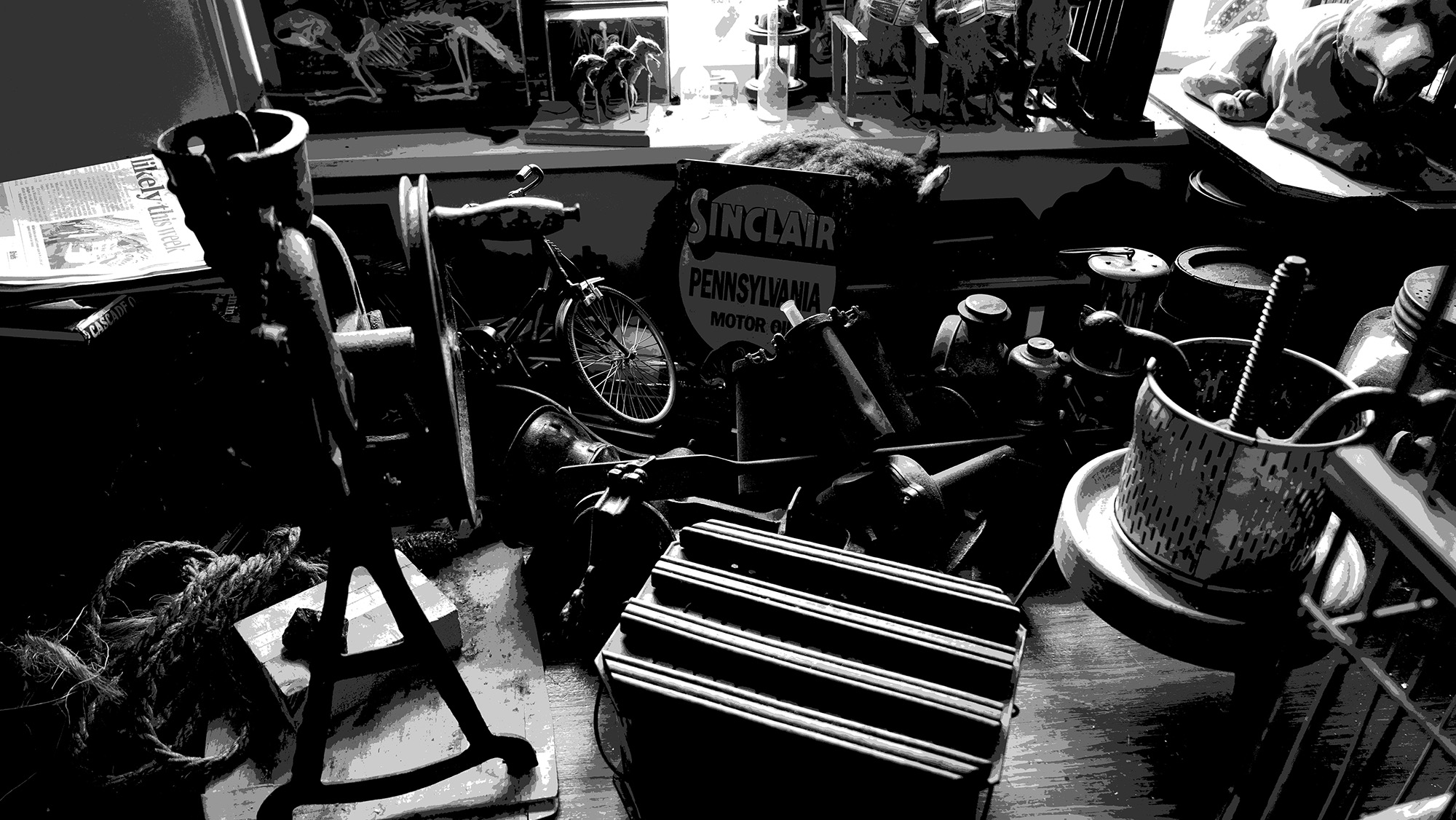
We exist in a world largely created, created by ourselves. It's a world filled, overflowing with things.
A digression. Initially, I used the term "objects," and after a moment I switched to "things." Someone might ask if this is the same thing? In this little tale of mine, the word "things" is more accurate. The dictionary definition of a thing is a material object. In this sense, the materiality of a thing also has significant significance.
Can we imagine life without these things? A rhetorical question.
Looking around, we see countless of them. They fill our world. Not only would it be difficult to count them, but also difficult to classify them. By function, matter, technology, or time of creation. Individual things or mass-produced. Things of various origins and natures. Hard things, soft things, of various consistencies. Of various weights and sizes, simple, single-component, and more or less complex. Immobile things
and those that seem to be brimming with life. Fragile, perishable things
and solid ones. Novelties and those whose moment of creation is lost in the mists of our memory. Gray, unassuming things, as if trying to avoid drawing attention, and colorful things, like butterflies or parrots, intrusively conspicuous. Pleasant to the touch, and those that fill us with revulsion. Repulsive.
Things that seem to be there for viewing, pleasing to the eye for reasons not always easy to define. Things we don't want to look at, yet they are there. Things created for contact with our bodies, like a shirt close to the body or a watch – a magical object measuring the passage of time, the nameless one and ours. Does their constant presence, the omnipresence of things, intrigue us, provoke reflection? I doubt it.
Reach into the recesses of your memory and tell me how many objects you own are two, five, ten years old? Do you have any that belong to your father, or perhaps your grandfather? For years, the greatest authorities have been warning against unbridled consumerism,
and yet, these appeals have shown no spectacular results.
Moreover, the number of consumers who, when they buy, don't satisfy specific needs. As strange as it may sound, the act of buying itself becomes a need. The "principle of hedonistic materialism" described by Fromm years ago is becoming a reality. At times, it seems that the watchword of modern industry is—cheap, fast, and in huge quantities. Far Eastern markets and countries, especially the Middle Kingdom, are having an increasingly significant influence on the phenomena described. The limitless resources of cheap labor and the economic transformations can be both impressive and terrifying.
Short-lived trends and fads are outrageous, appearing in the aura of discovering new perspectives, but in reality, they end up resembling blown-out eggshells. I would like to recall at this point a definition of design, in my opinion one of the most important, appearing in the writings of Professor Andrzej Pawłowski – design as designing the result.
Design understood in this way carries with it the responsibility of the designer. "A poorly designed product that functions efficiently is just as unethical as a beautiful product that doesn't. The former disregards the consumer, the latter deceives them." New materials and technologies impose increasing responsibility on the designer for the true purpose of design achievements. These are no longer just monstrous landfills that cannot be recycled, a consequence of our existence, but are, in fact, materialized evidence of an unbridled pursuit of the happiness of possession. It is also a deadly exploitation of all resources. However, in my opinion, what comes to the fore is what I would call uncontrolled consumer design, or rather, human design. Designers, without even realizing it, are designing people. We, the modern-day demiurges! Paradoxically, there's nothing to celebrate.
Quote - Paul Rand, Seeing-Knowing, Karakter, Kraków 2011, sts 307