perception
Professor Jan Nuckowski
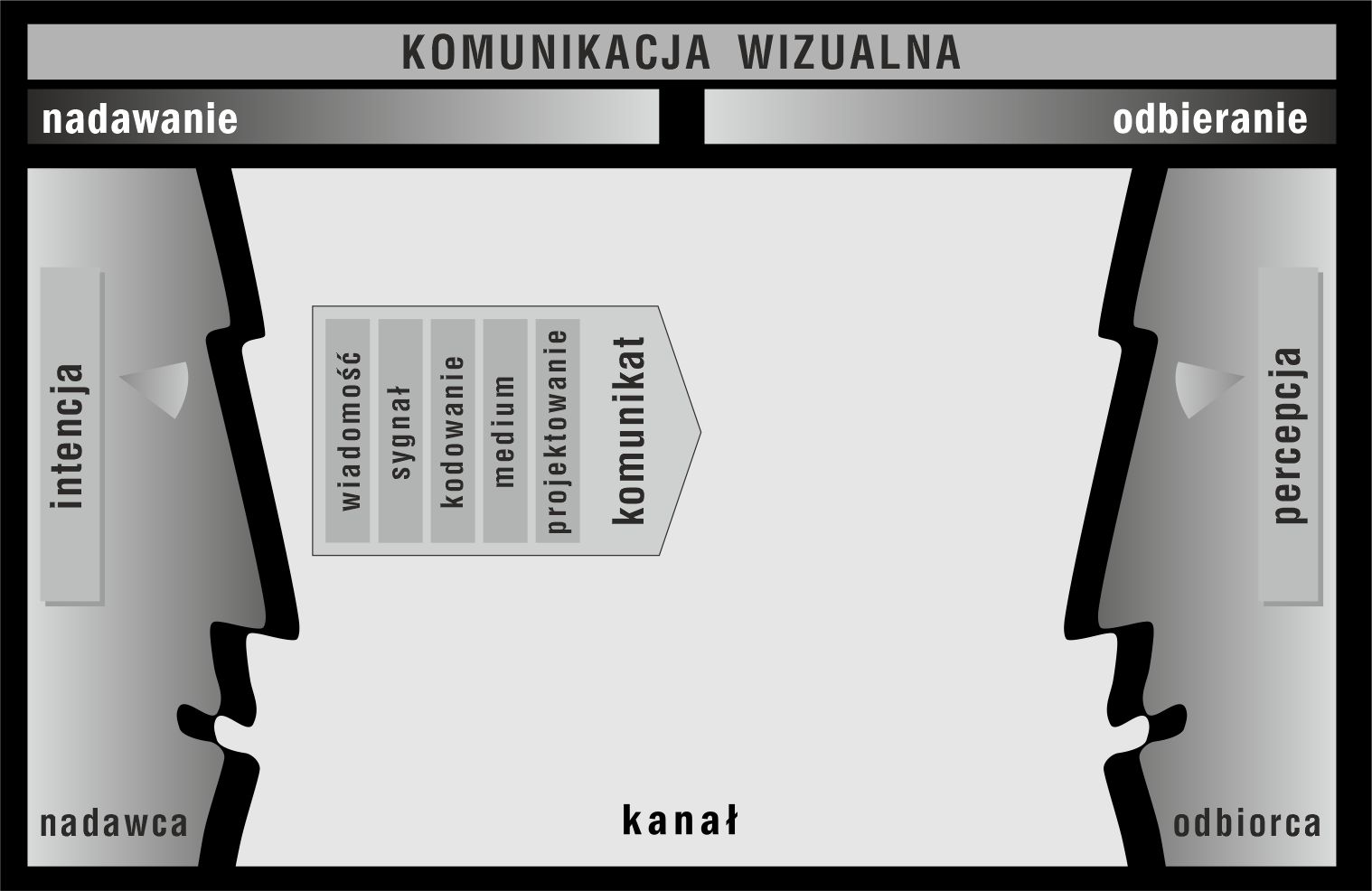
While teaching visual communication classes, I kept in mind a phrase I often heard during my studies – "rational design methods." This term is derived from the Latin word "ratio" – reason. To design rationally, one must rationally perceive the world and all the processes around us. Recognizing these processes will facilitate rational design that will change our surroundings. This, of course, also applies to visual communication design, as it significantly determines our existence. Hence, my lectures included issues related to this perception and understanding of the world, including the issue of perception. I accompanied all my lectures with relevant illustrations, or in this case, simple animations.
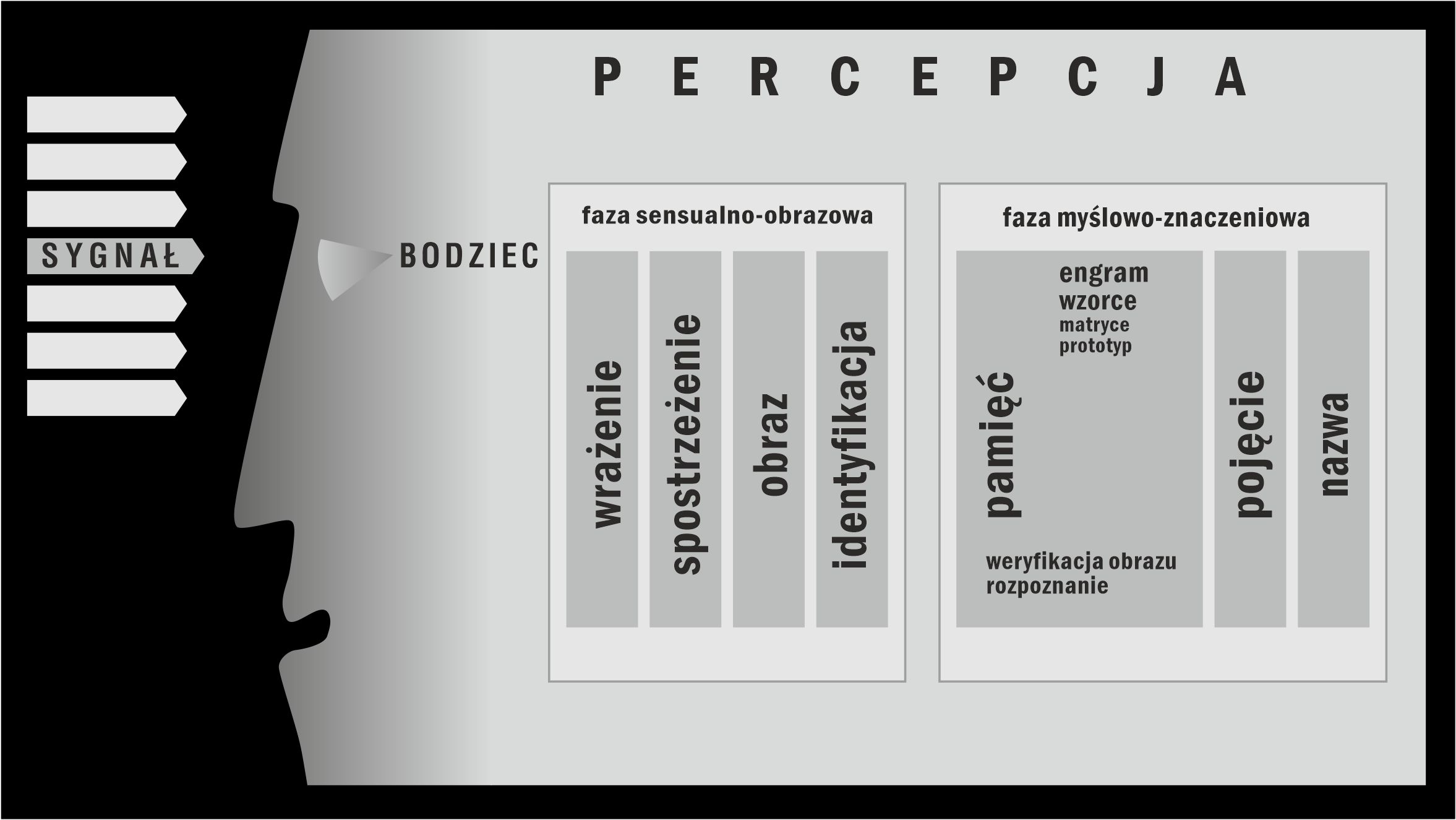
The human environment is filled with countless objects and an equally rich spectrum of processes. Our existence in this vastness is possible thanks to our perception. Perception is a complex mental process, composed of specific phases and elements. It is a phenomenon to which we owe our mental representation of the environment. These objects, phenomena, and processes emit signals. These are portions of energy of various categories. Some of them are a specific description of the state and quality of the environment, while others are evidence of any changes occurring within it.
The senses provide us with specific sensations thanks to receptors. These receptors are specialized neural tissue capable of converting the energy of specific signals into neural stimulation. Receptors can be single cells or entire organs. They are believed to be distributed throughout parts of our body, which are referred to, in a difficult-to-define sense, as the body's surface.
Receptors are divided into those capable of receiving external signals (exteroreceptors) and those receiving signals from within the body (interoreceptors). The former are divided into telereceptors, which respond to signals arriving through space, and contact receptors, which receive signals through direct contact between our body and their source.
For perception to occur, the signal must reach the appropriate receptor. One specialized in responding to a particular form of energy. This is called receptor modality. The eye cannot respond to sounds, even extremely strong ones, just as the ear cannot respond to light. A signal that triggers a stereotypical receptor response is called a stimulus. This involves a change in the level of excitation and a specific transformation. This occurs, namely, the conversion of the signal energy into bioelectrical activity. In essence, every stimulus, regardless of the type of energy of the signal that stimulates it, can be registered as changes in the nervous system in the form of electrical impulses. These impulses, stimuli—information about changes in receptor excitation—are transmitted through appropriate neural connections to various levels of the nervous system,
including the brain.
As a consequence, specific physiological or psychological reactions occur. In the latter case, these are specific, content-based traces registered by our consciousness. The simplest such trace is an impression. This elementary form of mental activity is a reflection of a single feature of an object in our field of vision. The redness of a flower is an impression. Consequently, an impression is a form of elementary cognition of objects accessible to our view. In psychology, impressions are said to be monosensory reflections of the environment. In reality, however, environmental objects never have such a simple, elementary structure.
True cognition consists of many impressions – an object is red, rounded, elongated, flat, etc. Moreover, it is important to remember that in a situation of true perception, we are always dealing with the activity of all the senses. Then knowledge of the world around us becomes complete, and only then do we encounter a holistic, multisensory reflection, that is, perception. It does include information from all the senses, but in varying proportions, as the senses are not equal. Nature has given priority to the sense of sight, significantly outweighing the other senses. It is estimated that we obtain slightly over 90% of information about our surroundings through sight. Perception in visual perception leads directly to the formation of an image. At this stage of perception, an image allows us to see what we see. Immediately afterward, we will be able to identify what we see, but this occurs through a specific recourse to memory. Therefore, an image is the psychological equivalent of what our gaze is directed at, which is the source of signals stimulating the visual receptors. However, it is important to remember that visual representation in natural conditions only directly informs us about the surface features of an object, which is related to its nature and the transmission of light.
Identification is a preliminary stage to recognition. It becomes possible after identification, which occurs through association. In this case, it involves the awareness of a name and the activation of a whole series of memory traces, content-wise related to the perceived object. Everyday, we recognize objects around us incredibly quickly and effortlessly, and we're even able to name these objects and even say something more about each one. Indeed, they can trigger far more complex reflections, often significantly different from what actually triggered them. The moment an image is identified, the first stage of perception ends, which I would like to call the sensory-image phase. I want to emphasize that we're dealing with a process that relies primarily on sensory data with little help from thinking. The moment an image appears, its comparison with what has previously been stored in our memory begins. In psychology, we talk about an engram. An engram is a permanent trace in our memory. A trace with specific content. It takes the form of changes at the level of the nervous system's structure. If the memory contains an image identical to the one we currently see, it is identified. The search for the identity of the seen object involves verifying it against the content of the engram. This is a sensory signal that acts as a pattern. Psychology recognizes two positions – the first, which sees a pattern as a matrix, and the second, which tends to attribute the nature of a prototype to it. A pattern—a matrix—would be a collection of unchanging features of a specific object. These features would be embedded in our memory through individual experience, becoming fixed in the form of an engram.
As can be seen, each of us is equipped with countless engrams, and over time, their number constantly grows. The extremely large number of these memory traces results from the fact that experience does not modify them. New traces can only appear, as even very similar objects differing only slightly must produce new traces. This thesis aligns with the law of perceptual constancy, which is so crucial for explaining phenomena such as shape constancy and size constancy.
Explaining these perceptual phenomena becomes possible by assuming that a certain tolerance in the difference between an image and a pattern is observed. This even indicates a preponderance of the pattern's influence over the image. The second concept mentioned above, the prototype, attributes to patterns the nature of a set of features describing an object. These features of all known objects are stored in memory, and from these, our minds create sets that uniquely define specific objects. This can be compared to a set of building blocks from which various objects can be constructed. When an image is identified, the sensory-image phase of perception ends, and the mental-meaning phase begins.
The moment an object is recognized, its name emerges from our memory. The image seems to generate a name, although it is uncertain whether names play a role similar to matrices in perception. Thus, the image is accompanied by a name, and immediately afterward, or simultaneously, a concept—a mental representation of the object—emerges. Concepts are mental in nature.
An image is a very specific set of impressions that uniquely correspond to—define—the perceived object. Therefore, it is, or can be, a source of information about the object. Furthermore, this information can include information about the spatial or temporal relationships between various objects. This information can be extracted from the image through a complex mental process. It involves comparing a sensory image with all our previous experience, with memory. During this process, information from the image code is transformed into a semantic form, into a concept—an elementary mental representation. A concept is said to be generalized knowledge about a class of objects, phenomena, or relationships.
Each table is in one sense unique, and in another, it constitutes a member of the class of tables.
Concepts are simplified models of certain real-world objects, and thinking consists of operations on such models. In psychology, names are said to be labels for concepts. Their main function is interpersonal linguistic communication.
I believe that this allows the previously mentioned phases of perception to be more clearly defined—the initial sensory-image phase and the much less understood mental-meaning phase that follows.
... it should be emphasized, however, that there is no uniform position in contemporary science regarding the transcoding of information from figural to verbal code. To date, no universal answer has been given to the question: must such transcoding always be mediated by a concept? In other words, is the process serial, in which case the transformation would proceed linearly: image – concept – name, or is it parallel: image – concept and image – name.
both quotes - Jan Młodkowski, Human Visual Activity, PWN, Warsaw – Łódź, 1998