In memoriam
Professor Jan Nuckowski
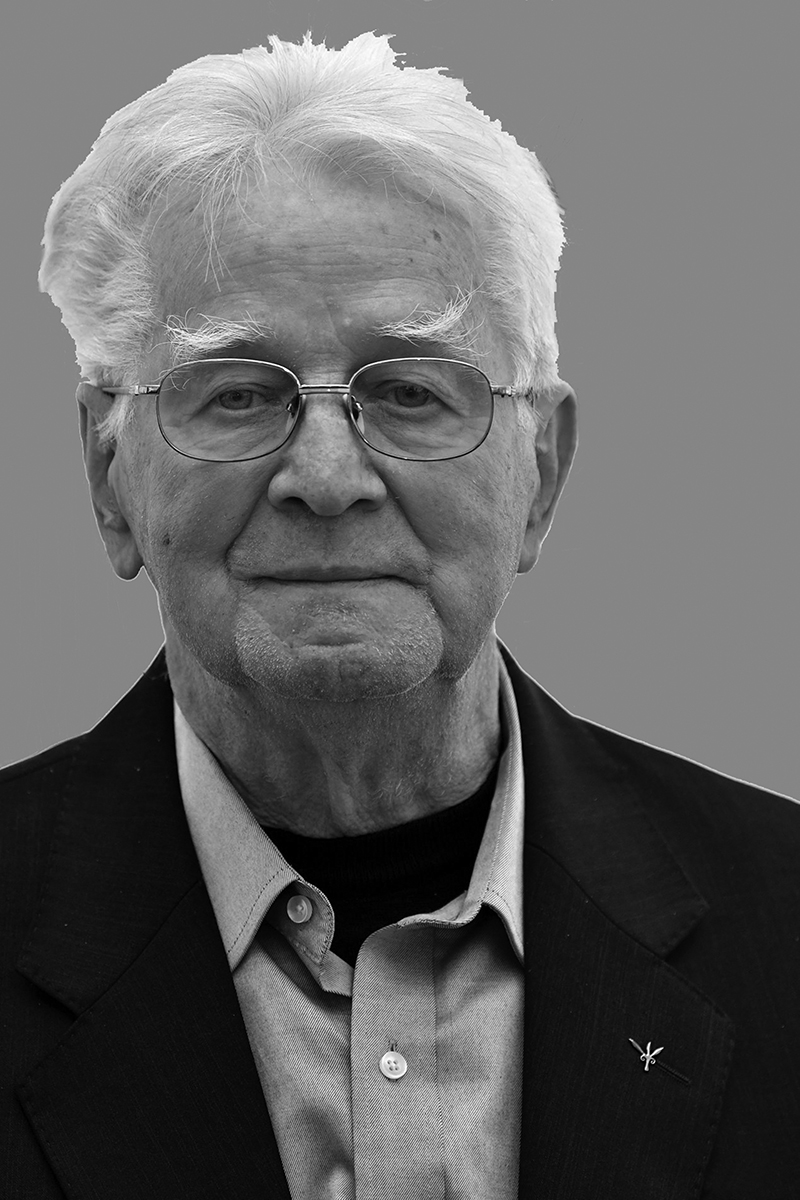
It's been over six months since we said goodbye to Professor Ryszard Otręba.
Walking through the cemeteries, we often read the dictum Non omnis moriar – not all of me will die. It's a fragment of Horace's ode - Exegi monumentum – I have built a monument to myself.
The monument to Professor Ryszard Otręba is impressive. I don't feel qualified to judge it. I have no doubt that others will do it better than me, more competently and calmly, without emotion.
Ryszard's death, though inevitable, was too painful for me.
I would like to tell you about my acquaintance with Ryszard. It was a significant time for me, building my image as a wonderful teacher, superior, colleague, and ultimately, a righteous man.
I met Ryszard in June 1966, during my university entrance exam. It was the second day of the exam for the Faculty of Industrial Design. The so-called practical exam took place on the third floor of the building at Smolensk 9, in Room 303. Back then, the room was a single spacious room. Only in the middle of the floor, a row of cubicles had been constructed from large drawing boards. Each cubicle had a small table and chair. On the tabletop was a piece of paper with a concise question – a task that had to be answered in writing or an exercise completed within 10 minutes. After that, at the sound of a bell, one had to exit the cubicle, move to the next, and begin the next task. And so on, 10 tasks in succession. Needless to say, the atmosphere was tense and focused.
In this peculiar obstacle course, in the next cubicle, I found a set of cutlery and instructions to evaluate its qualities. A trifle. I move to the next station, and there's cutlery again, slightly different, and the instructions on the sheet seem identical to the one I had just taken.
My brain is racing, I look at my watch as the 10 minutes tick away, and I don't know what to write. A boy stands next to my station – a small, slender figure. I think – probably a student supervising the exam takers. I nod at him and whisper for advice. "You, give me some advice, because just a moment ago at the previous station there was a similar question. What should I write back?" The boy gave me some advice. I answered the question on time.
When, after the exam, someone pointed out to me that the boy was Associate Professor Ryszard Otręba, I was terrified. I thought it might not be a good start. I took the exam anyway. To what extent this suggestion had an impact, if it had any at all, God knows. I didn't ask.
Ryszard left immediately afterward on a scholarship from the US State Department. In my third year, the professor taught painting classes, which were officially called Visual Arts Studies in the program. After Professor Haska in my first year and Jurek Panek in my second year, I took Otręba. Completely different worlds, a different approach, a different atmosphere. In Room 9, on the first floor, at Ryszard's initiative, we set up a corner in the studio with a kettle, drank tea, and discussed various topics during breaks.
Several times, this conversation took the form of one-on-one conversations. Ryszard spoke about his experiences, reflections, and assessments of artistic phenomena. Such incredibly personal lectures. Why me? I don't know, but these conversations became the impetus for my work. If I ever painted something that transcended mediocrity, it was in that particular year.
In my fourth year, we chose a diploma department – I chose Visual Communication. To be precise, at that time, it was the Visual Communication Studio, which only gained its Department status in 1972. To make my subsequent recollections more understandable, I must admit that I have a stubborn and impatient nature. My nerves sometimes got the better of me, and in such moments, I forgot to exercise proper self-control. Despite this, the professor repeatedly showed me extraordinary understanding and generosity.
Fourth year of studies, summer semester, proofreading. I presented my concept, but the professor wasn't pleased. Ryszard never expressed it directly; it was often indirect remarks, recollections from his many travels, what he had seen, digressions that required careful consideration, which wasn't always easy.
Never mind, after a week or two, I presented another project, but the situation repeated itself. During the next proofreading, the professor's lack of acceptance caused me to make a somewhat impulsive comment, and then I left the room. My then-assistant, the late Janusz Depta, ran after me with a just reprimand. How are you behaving? What words? To the professor!
I didn't show up at the Department until the end of the semester, risking failing the exam and maybe even repeating the year.
During the semester break, I was already at Smolensk for some reason. I was walking down the corridor, and Professor Otręba was walking across from me – good morning – good morning. We passed each other, but after a moment I heard, "Sir!" I turned around – yes, I'm listening, Professor. I was expecting a proper argument. Instead, I heard these words – "Back then, during that correction, you were right to get angry, but I still gave you a very good grade!"
The ceiling fell on me! How many teachers would have such a reaction in such a situation? I somehow didn't feel successful.
This incident should have been a lesson to me at the time, but it didn't quite work out that way. In those days, studies lasted six years, and the final year was the graduation year. After the topic was determined, students were expected to attend regularly to present their progress. During each subsequent correction, the professor, in my opinion, devoted more of his attention to his colleagues from lower years than to me. I'm ashamed to admit it, but it really bothered me – what do you mean, I'm doing my degree and I have to wait for corrections?
I stopped showing up. Now I know it was unacceptable arrogance. However, the professor once again demonstrated extraordinary understanding and generosity. To this day, when I think about it, I'm deeply ashamed. Despite this, quite frankly, arrogance, Ryszard allowed me to defend my thesis.
Furthermore, after the defense, Professor Otręba approached me, congratulated me, and said, "Thank you for not letting me down, because when I allowed you to defend, I wasn't sure if it was the right decision." In 1973, Ryszard offered me a position, along with the late Marysia Banaś-Majkowska, in an interdisciplinary team tasked with developing a study of visual information for a complex of stations near the Kraków City Communication Center. These were to be combined railway, bus, and LOT Polish Airlines stations, and public transport. Construction of a pre-metro was also planned. It was to be a large, multi-functional facility for the time. A significant distinction right after my thesis defense.
This relates to an anecdotal incident. When organizing an interdisciplinary team, the Railway Design Office asked the designers of the Praga Metro to recommend someone to handle visual information. The answer was: "You're looking for help from us, and yet you have a wonderful specialist in Krakow – Ryszard Otręba. If I remember correctly, it was Jan Rajlich, a Czech graphic designer who knew Ryszard because they were both representatives at ICOGRAD. It's sad to mention that nothing remained of the several months of work on this project. As in those days, there was no respect for human labor or the resources invested in such often serious and expensive undertakings.
In 1978, the professor invited me to work at the university, initially on a contract basis, and from 1981 on a full-time position. I hold the entire period of our work together at the university in grateful memory. In fact, I feel that Ryszard largely "designed my life."
That's all for my ramblings about friendship with the professor. I'm using this term because Ryszard himself put it that way.
However, it's essential to mention his relationships with students. Ryszard was very well-liked by students. There are many examples of this, including numerous cathedral events in open-air spaces and private homes. A prime example was the large group bidding farewell to Ryszard at the train station in 1981 when he was leaving for Australia on a contract. The singing, shouting, and banners caused quite a stir among the people filling the station platform. The story repeated itself during the professor's next trip in 1984. During Ryszard's absence, I taught classes for the students in his place. I remember one day picking up mail at the reception desk – a postcard from Sydney. A few words about how the stay was going, a question about how you were doing, and finally, "I wish you were here."
In conclusion, I will repeat what I already said during the laudation of Ryszard, Honorary Professor of the Jan Matejko Academy of Fine Arts in Krakow - "Laus illi de betur et a me gratia maior" - "He deserves praise, and even greater gratitude from me."